
Performance Management System : KPI vs OKR
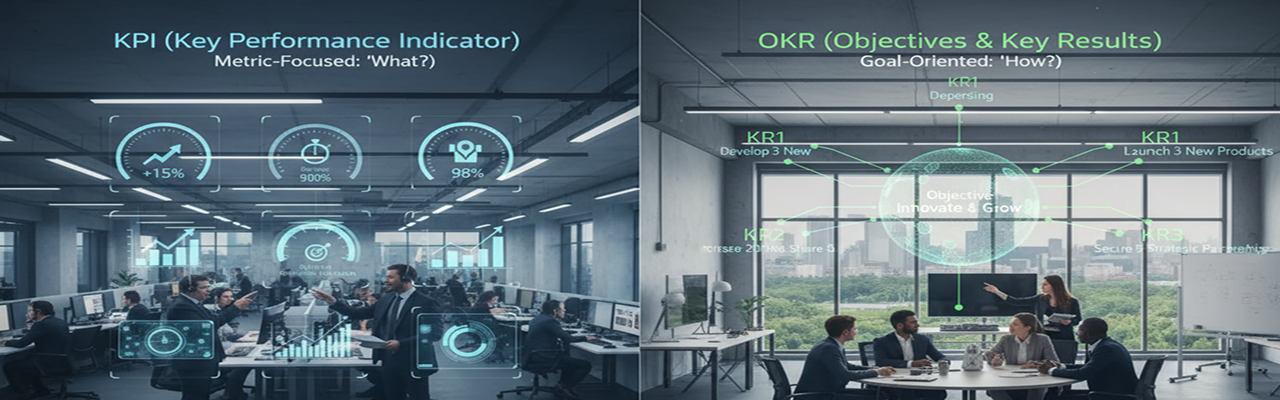
Effective performance management is widely recognized as a cornerstone of organizational success and a key factor in supporting continuous improvement. Companies that implement robust performance management systems are better positioned to adapt to market changes, foster employee motivation, and achieve strategic objectives. Research from McKinsey reveals that organizations that emphasize their people’s performance outperform their peers by 4.2 times, achieving 30% higher revenue growth and five percentage points lower attrition rates compared to those that don’t [1]. This finding underscores a critical truth: when companies invest in a clear performance system, they not only drive financial growth but also build a more engaged and loyal workforce.
This raises an important question: how should organizations effectively manage performance? Two of the most established and impactful frameworks are KPIs (Key Performance Indicators) and OKRs (Objectives and Key Results). Google serves as a well-known example of the impact of OKRs. In its early days, the company embraced the framework to set ambitious targets, including the goal of generating 20% of its revenue from advertising. By surpassing this objective, Google not only achieved a breakthrough in performance but also reshaped its business model, laying the foundation for its transformation into a billion-dollar enterprise. Intel relied on OKRs during the 1980s to reclaim leadership in microprocessors, while Spotify uses OKRs to align its fast-growing teams toward innovation and customer experience [2].
On the other hand, KPIs have been a cornerstone of performance measurement across various industries, including manufacturing, logistics, and retail. Between 2011 and 2020, KPIs emerged as a dominant approach in performance tracking, enabling organizations to improve accountability, decision-making, and evaluate progress against strategic plans [3]. The implementation of KPIs has generated a significant impact on hospital performance. For instance, KPIs enabled the evaluation of X-ray services' effectiveness, resulting in a 47% increase in hospital efficiency and a 96% improvement in radiographer productivity [4]. In the public sector, the establishment of key performance indicators for monitoring dashboard models has also proven valuable, particularly in supporting government procurement processes [5].
The choice of methods used by different types of companies to enhance performance through KPIs and OKRs has long been a subject of debate among Human Capital professionals. A comprehensive understanding of performance management methods requires careful consideration of the distinct goals, organizational structures, and operational models that characterize each organization. To begin, KPIs are a set of metrics that measure and quantify the success of a specific business component [6]. They are used to measure the performance of a company, department, or individual, but the purpose remains the same: to determine if a certain aspect of the business is “on track” and is headed in the right direction, or if it needs improvement [7]. KPIs also provide a way for managers to assess the progress of their employees, departments, or processes over time, and make better-informed decisions about the performance of their team. The implementation of KPIs helps organizations evaluate the effectiveness of their strategies and identify new opportunities for growth, making them a critical tool in strategic planning and continuous improvement.
OKRs, on the other hand, are linked to increased transparency, employee engagement, and alignment with organizational strategy, making them valuable for innovation-driven and rapidly changing environments [8]. OKR, which stands for Objectives and Key Results, is a performance management tool designed to help organizations define ambitious goals set by top-level decision makers while aligning those goals with the objectives of individual employees [9]. Generally, individual employees must set three to five SMART objectives, each with three key objectives [10]. SMART means that the objectives should be specific, measurable, achievable, and relevant to the institution’s main goal and within a specified time frame. Ideally, these objectives should align with the organization’s overall goals and the department’s operational plan, thereby enhancing employees’ comprehension and awareness of the company’s strategic direction.
So how should the initial question be addressed? What types of strategies or organizational goals are best suited for OKRs or KPIs? The answer lies in understanding the nature, maturity, and strategic direction of the organization. OKRs are particularly effective for companies aiming for innovation, agility, and transformational growth, as they focus on ambitious, qualitative objectives and encourage alignment across teams in a flexible and forward-looking manner. Companies that depend heavily on innovation, fast-paced environments, and a strong focus on growth—such as tech firms and startups—can gain significant value from implementing OKRs. This framework offers a structured yet adaptable approach that enables teams to establish bold and ambitious goals while ensuring they remain aligned with the organization’s overall mission [8]. KPIs provide a measure of performance that can be compared to industry standards or other companies in the same sector. They enable businesses to track their progress and make informed decisions about where to focus their resources. KPIs generally fall into two main categories: financial and non-financial. Financial KPIs are used to assess a company’s profitability and overall financial health, with common examples including Return on Investment (ROI), Return on Equity (ROE), and Earnings Before Interest, Taxes, Depreciation, and Amortization (EBITDA). On the other hand, non-financial KPIs are more suitable for evaluating aspects such as customer engagement, employee satisfaction, and operational efficiency. Metrics like customer retention rate and employee turnover rate are commonly used to monitor these dimensions of performance [7]. KPIs serve as essential tools for evaluating organizational performance by providing measurable insights that align with the company’s needs and are implemented through a structured performance management framework.
Both KPIs and OKRs play vital roles in shaping effective performance management systems, and the choice between them—or the decision to combine both—should be guided by an organization’s strategic priorities, structure, and operating environment. KPIs offer clear, quantifiable metrics that support operational accountability and continuous improvement, making them ideal for tracking performance across stable, process-driven industries. Meanwhile, OKRs provide the flexibility and ambition needed in fast-moving, innovation-led organizations, where alignment and adaptability are critical to growth. Rather than viewing these frameworks as mutually exclusive, organizations can benefit from integrating KPIs to monitor ongoing performance while leveraging OKRs to drive strategic change and innovation. When implemented thoughtfully, both tools empower companies to align their people with purpose, enhance decision-making, and build a culture of performance that supports long-term success.
Performance management is more than just tracking numbers—it’s about shaping behaviors, driving alignment, and enabling growth. HR plays a central role in designing and embedding KPI and OKR systems that balance accountability with innovation, ensuring performance frameworks strengthen both people and business outcomes.
Key areas where HR adds value in performance management include:
Area | Role of HR Consulting |
|---|---|
Performance Analysis | Evaluate results through KPIs and OKRs, providing insights that drive continuous improvement and strategic alignment. |
Change Management | Guide adoption of performance systems by fostering awareness, providing training, and reducing resistance. |
Leadership Enablement | Support leaders and managers in setting clear KPIs or ambitious OKRs, and in motivating teams to achieve them. |
By embedding performance analysis, guiding change, and enabling leaders, HR ensures that KPIs and OKRs are not just tools on paper but living frameworks that drive results. With the right HR Consulting support, organizations can align performance systems to their strategy, engage employees more deeply, and turn measurement into meaningful growth. Partnering with FED Insight helps you unlock the full potential of your performance management system, turning data into decisions and goals into achievements.
Tags: