
Effective Organization in The Age of AI

Artificial intelligence (AI) is no longer just a tech upgrade—it’s a powerful driver of how organizations work, learn, and compete. Like the internet or the steam engine in past revolutions, AI is reshaping business at its core. McKinsey estimates that generative AI alone could automate up to 70% of business activities by 2030, unlocking trillions in economic value.
Yet despite rising investments, few companies have fully embedded AI into how they operate. Many still rely on outdated structures and siloed teams—models that weren’t built for the speed and complexity AI brings. The real transformation isn’t just about automation; it’s about rethinking how decisions are made, how work gets done, and how humans and machines collaborate.
To succeed, organizations must go beyond deploying tools—they must redesign roles, workflows, and leadership models to unlock the full potential of AI. As Harvard’s Professor Karim Lakhani puts it, “AI won’t replace humans, but humans with AI will replace humans without AI.”
In this AI era, agility, adaptability, and continuous learning will define organizational effectiveness. The future belongs to those who can combine human talent and machine intelligence—seamlessly and strategically.
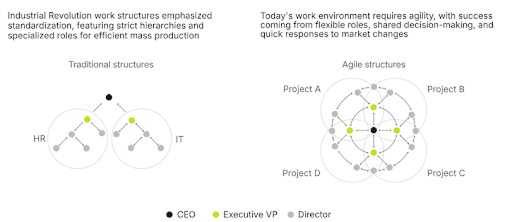
The rise of AI and the acceleration of digital transformation have triggered a fundamental shift in how work is organized. Traditional organizational models—built around fixed job titles, rigid hierarchies, and clearly segmented departments—are struggling to keep up with the rapid pace of change. These legacy structures, once optimized for efficiency and predictability, are increasingly seen as barriers to innovation, speed, and adaptability.
In contrast, today’s work environment demands more agile and skills-based models, where roles are fluid, decision-making is shared, and talent moves dynamically to where it’s most needed. Companies are learning that success no longer depends on job titles or tenure, but on capabilities that can evolve quickly. The workforce is not only multigenerational, but also facing dramatically shortened skill half-lives—averaging under five years and even less for technical roles. According to the World Economic Forum, 44% of core skills will be disrupted within five years, and 23% of jobs will fundamentally change.
This talent disruption is not a future concern—it’s already underway. More than half of employees report that AI has significantly altered their work, highlighting the urgency to shift from job-based structures to skills-based strategies. Agile operating models provide a flexible foundation for this transformation. Unlike traditional models that are built around departments and reporting lines, agile structures organize work around projects, squads, and outcomes. This allows companies to respond faster to changing demands, redeploy talent more effectively, and unlock innovation across silos.
At the same time, organizations must rewire how they design roles and manage talent. Roles are becoming obsolete faster than organizations can revise job descriptions. Instead of anchoring people to a fixed job, companies are rethinking work design around evolving skills, real-time business needs, and collaboration with AI. This shift repositions leadership teams—not just as executors of strategy—but as architects of talent ecosystems, capable of continuously aligning skills with strategy.
(Oliver Wyman Forum)
According to Oliver Wyman Forum, 60% of employees want to work in a skills-based organization, and forward-thinking companies that have embraced agile models report 60% faster market delivery and 59% faster innovation. Still, many businesses fall short. Nearly two-thirds of employees say their current learning and development programs don’t equip them for success in this new environment.
To close this gap, organizations must view skills as the new currency. Talent mobility, adaptability, and continuous learning must be built into the operating model—not as a separate HR initiative, but as a core business capability. Adaptive leadership is key. As one insight from McKinsey notes, the goal is no longer to match people to jobs, but to design systems where skills flow freely across projects, AI complements human expertise, and organizations scale at the speed of change.
AI is not just transforming technology—it’s fundamentally changing how talent is managed, developed, and retained. A future-ready talent strategy must reflect this shift, with HR leaders and organizations moving beyond traditional approaches to embrace AI as a core enabler of workforce performance and agility.
AI enhances nearly every touchpoint in the employee lifecycle—from sourcing and screening candidates more effectively, to streamlining onboarding, enabling real-time feedback, and designing personalized learning journeys. It empowers HR teams to forecast staffing needs, identify skill gaps, and predict attrition risks, all with greater speed and accuracy.
This level of insight allows organizations to design more adaptive and data-driven talent strategies. Instead of one-size-fits-all programs, AI enables customized development paths, smarter hiring decisions, and more precise workforce planning—helping companies stay responsive in a rapidly changing market.
To fully unlock this potential, however, organizations must ensure their HR practices evolve alongside technology. That includes equipping leaders with the skills to work with AI, redesigning roles to blend human and machine strengths, and fostering a culture where continuous learning and adaptability are the norm.
While AI has its advantages, it also raises critical questions: What are the risks to fairness, security, and inclusivity? How can leaders ensure AI supports—not replaces—people?
Based on key insights from Harvard Business School experts, here are five ethical dimensions businesses must manage:
- Digital Amplification
When algorithms prioritize certain information, shape public opinion, or highlight specific voices, they can unintentionally skew perspectives—especially in recruitment, performance management, or communication platforms.
- Algorithmic Bias
AI tools trained on biased data can lead to unfair outcomes—such as discriminatory hiring or unequal access to career opportunities. For example, AI might favor resumes from one demographic over another based on historical patterns.
- Cybersecurity
AI systems often handle personal and organizational data, making them prime targets for cyberattacks. Phishing, ransomware, and data breaches are rising threats.
- Privacy
AI-driven platforms analyze vast employee data to generate insights. But without strict governance, this could lead to unauthorized use, surveillance concerns, or misuse of personal information.
- Inclusiveness
Some sectors—like manufacturing or traditional retail—may struggle to adopt AI at the same pace as digital-native industries. This can widen inequality and leave certain job types or communities behind.
By addressing these five areas, organizations can move beyond simply “using AI” to adopting AI responsibly—ensuring it becomes a tool for empowerment, not displacement. In doing so, they not only safeguard their workforce but also build a stronger, more resilient business culture in the age of AI.
As AI continues to transform the way organizations operate, one thing becomes increasingly clear: technology alone is not enough. The true competitive edge lies in how businesses align their human capital with digital innovation. In this transition, HR consultants play a critical role as strategic enablers—not just system implementers, such as:
- Translating AI ambitions into workforce realities
- Designing adaptive and inclusive workforce models
- Upskilling, reskilling, and workforce transition planning
- Embedding ethical and human-centered practices
The future of work isn’t just digital—it’s human and digital. Organizations that succeed won’t be the ones with the flashiest tech, but those that can integrate people, technology, and purpose into one unified strategy.
HR consultants who understand both the language of talent and the language of transformation will be essential partners on this journey. By designing adaptive talent strategies grounded in ethical, forward-looking principles, they help organizations not only respond to change—but lead it.
Tags: